
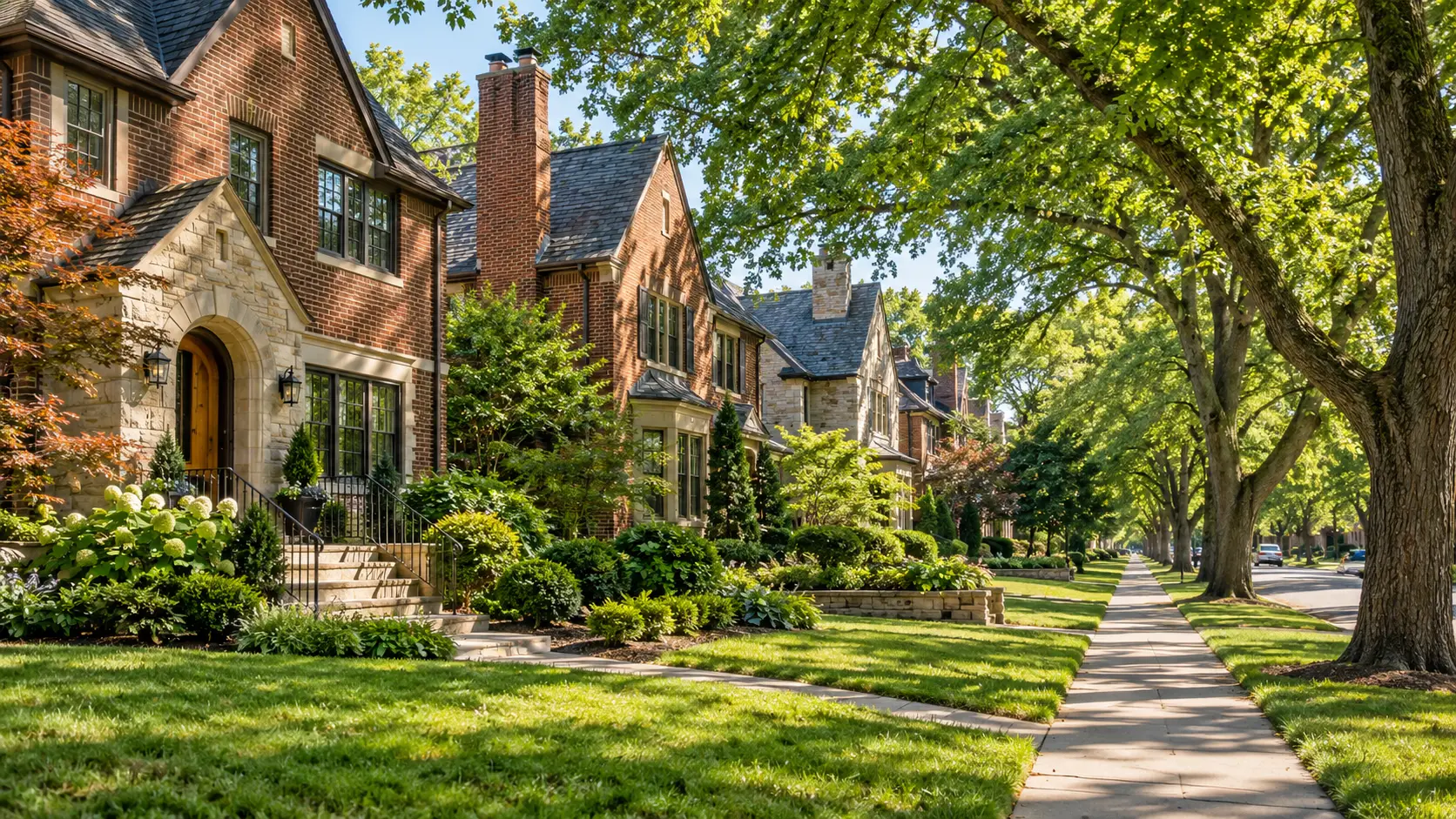
To understand Bexley, start on Broad Street, turn south through the residential blocks, spend time at Jeffrey Mansion and Park, and finish on Main Street near Capital University and the Drexel Theatre. In a short drive, you move from large historic homes and formal landscapes to cottages, Tudors, Colonials, duplexes, campus activity, local restaurants, and a walkable commercial corridor. That variety comes from Bexley’s history: the northern Bullitt Park area and the southern Pleasant Ridge community developed separately before joining to form the city. Today the community is compact, architectural, and closely connected to central Columbus—but the daily experience still changes meaningfully from north to south.
1. A Compact City With A Strong Identity
Bexley’s compact size is part of its character. The city covers only a few square miles, bounded by Alum Creek on the west and surrounded by Columbus, yet it has its own municipal identity, parks, civic institutions, and commercial corridors. North Bexley grew from the Bullitt Park area, where prominent Columbus residents built country homes and estates near Broad Street. South Bexley traces part of its identity to Pleasant Ridge and Capital University. Those origins are still visible in the housing scale, street pattern, and relationship to Broad Street, Main Street, and Livingston Avenue. A buyer is not simply choosing “Bexley”; they are choosing a particular part of that history and the routine that comes with it.
2. Main Street Is The Everyday Center
Main Street gives Bexley an active spine rather than leaving the community entirely residential. Capital University anchors the western part of the corridor, while the Drexel Theatre, restaurants, coffee shops, local businesses, civic buildings, and neighborhood services create regular foot traffic. Living near Main Street can make dining, entertainment, errands, and campus events easier to reach, but proximity also affects parking, road noise, and activity. Broad Street has a different character, with larger homes, institutional properties, mature landscaping, and a more formal streetscape. Buyers should spend time on both corridors and the connecting residential streets; a few blocks can change the feel of the location considerably.
3. The Architecture Has Lasting Character
Bexley’s residential architecture is one of its defining assets. Homes from the early twentieth century include brick and stucco Tudors, Colonials, English-inspired cottages, larger estates, duplexes, and smaller homes built for the city’s more compact blocks. Mid-century properties, condominiums, major renovations, and newer replacement homes add another layer. North Bexley near Broad Street generally presents a different scale from the streets around Main and the Capital University area, while southern sections introduce their own lot patterns and access points. Original woodwork, tile, slate, masonry, and built-ins can be exceptional, but the quality of stewardship matters. Compare the house’s systems and renovation history with the architecture you are paying to preserve.
4. Jeffrey Mansion And The Parks Add Real Outdoor Value
Jeffrey Mansion and Jeffrey Park are among Bexley’s most distinctive community assets. The park includes woodland paths, Alum Creek, open space, recreation facilities, a pool, and the historic mansion itself. Schneider Park extends the outdoor experience along Alum Creek with a crushed-limestone path, playground, splash pad, community gardens, and a more natural setting. Commonwealth, Havenwood, and smaller neighborhood parks give residents additional green space close to home. These are not interchangeable amenities: one buyer may want a quick walk to Jeffrey Park, while another may prefer Main Street access or a quieter interior block. Visit the nearest park and walk the route from the property before deciding how much that access matters to you.
5. The Central Location Works
Bexley’s location east of downtown makes it convenient to central Columbus, the Near East Side, Franklin Park Conservatory, Olde Towne East, major hospitals, the airport corridor, and east-side employment centers. Main Street and Broad Street provide the primary east-west routes, while Alum Creek and surrounding Columbus neighborhoods shape north-south travel. The compact street grid can support walking and biking for some trips, but traffic and crossings vary. Buyers should test their actual commute and daily errands from the address. A home close to Main Street may offer easy access to restaurants and services; a property farther from the corridor may trade convenience for a more purely residential setting.
Older Homes Reward Careful Evaluation
The most useful Bexley inspection starts with the home’s age and renovation story. Look at the roof, masonry, foundation, grading, drainage, sewer line, electrical service, plumbing, windows, insulation, HVAC, fireplaces, and any additions. Ask what was preserved, what was replaced, whether permits are available, and how water moves around the property during heavy rain. Garages and driveways can be smaller or configured differently than in newer suburbs, and mature trees bring both beauty and maintenance. None of this is a reason to avoid an older home; it is how you distinguish a well-cared-for property from one that may require a larger near-term investment.
Buying Or Selling In Bexley Requires A Local Comparison
For buyers, compare homes from the same section of Bexley with similar architecture, condition, lot, garage arrangement, and renovation quality. A Broad Street estate, a cottage near Main Street, and a property south of Capital University serve different markets even when their square footage overlaps. For sellers, document the work that protects the home’s character and function: roof, masonry, windows, sewer, electrical, mechanical systems, additions, and thoughtful interior updates. Marketing should connect the house to its real surroundings—Jeffrey Park, Main Street, Capital University, Broad Street, or a quiet residential block—without reducing Bexley to generic claims about charm.
Considering A Move To Bexley?
Ryan Grover can help you compare Bexley’s different blocks and housing styles, evaluate the condition behind the character, and build a buying or selling strategy around the property’s real local advantages.
Talk with RyanFrequently Asked Questions
What is Bexley best known for?
Bexley is known for its historic architecture, mature streets, Main Street businesses, Capital University, the Drexel Theatre, Jeffrey Mansion and Park, and its close-in location east of downtown Columbus.
What should buyers inspect in a Bexley home?
Inspection priorities often include masonry, roof materials, drainage, foundation, sewer line, electrical service, plumbing, windows, mechanical systems, fireplaces, additions, and renovation permits. The right scope depends on the specific property.
Which parts of Bexley feel most walkable?
Homes near Main Street, Capital University, Jeffrey Park, and the central civic area may offer the strongest walking access to restaurants, services, parks, and institutions. Always test the exact route and street crossings.
Are all Bexley homes historic?
No. Bexley has a large inventory of older homes, but the city also includes mid-century properties, condominiums, duplexes, substantial renovations, and newer replacement homes. Architecture and condition vary by block.
Explore Bexley: Bexley parks and Jeffrey Mansion · City of Bexley history · Bexley plans and Main Street · Franklin County property records


Join The Discussion